Why is my Oura readiness score low?
Research-based: built from manufacturer specs and published studies. Not a hands-on test.
How Oura builds the score
Oura's readiness score runs from 0 to 100. It mixes short-term signals from last night (your lowest resting heart rate and when it happened, average body temperature, sleep quality, and yesterday's activity) with longer-term "balance" measures for HRV, sleep and activity.[1] The balance measures compare your last 14 days, weighted toward the last two to five, against your average over the past two months.[1] In other words, the score compares you with yourself.
Oura's bands: 85 to 100 optimal, 70 to 84 good, 60 to 69 fair, 0 to 59 pay attention. It says 100s are designed to be rare.[1][2]
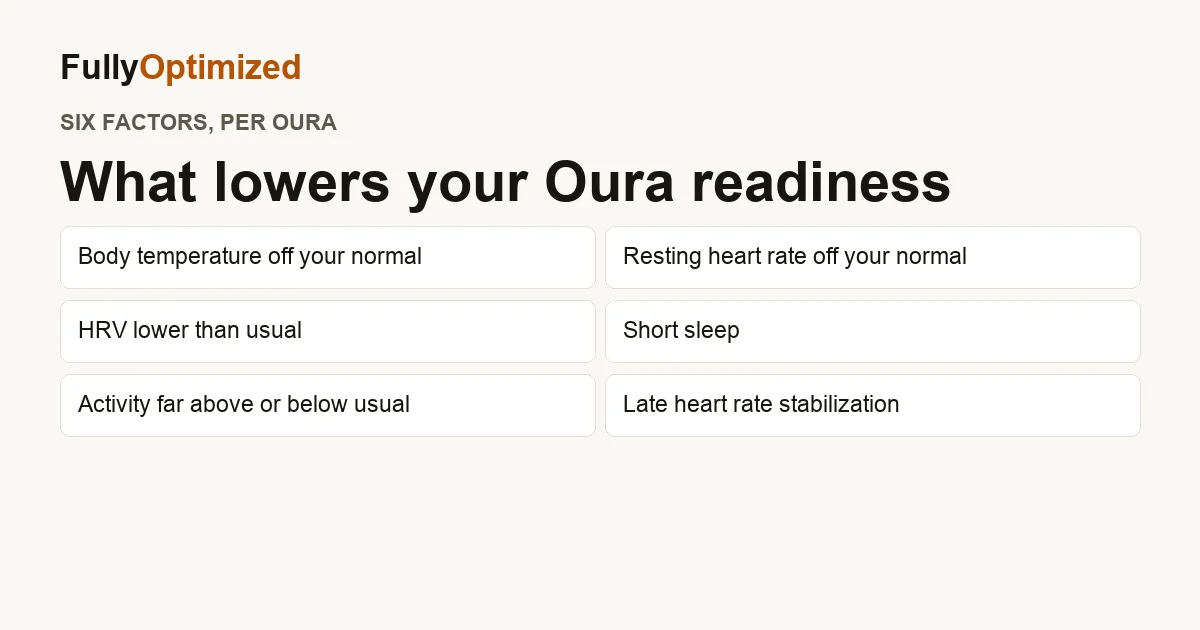
The six things Oura says pull it down
- Body temperature that is higher or lower than usual. Oura says higher temperature may signal stress on the body such as illness, and lower temperature can reflect normal changes such as the menstrual cycle.[1]
- Resting heart rate that is higher or lower than usual. Higher suggests you are not recovering; lower can mean low arousal, per Oura.[1]
- HRV that is lower or much higher than usual. Lower can be a sign of stress or strain.[1]
- Consistently short sleep. Oura points to the American Academy of Sleep Medicine guidance that adults need 7 to 9 hours.[1]
- Activity balance far above or below your norm. Overdoing it, or doing much less than usual, both count.[1]
- Late heart rate stabilization. Oura looks at when your resting heart rate settles within 3 beats per minute of the night's lowest. Later in the night means less recovery time.[1]
The usual culprits behind those signals
Alcohol
Oura lists alcohol among the most common things that lower the score.[2] The sleep research agrees on the direction. A 2025 meta-analysis of 27 studies found alcohol delayed and reduced REM sleep even at low doses of about two drinks, with bigger effects at higher doses.[3] Our own Oura has shown worse overnight numbers after drinks or late meals, which is a big part of why we cut back; see our year-long Oura review.
Caffeine too late
A 2023 meta-analysis found caffeine cut total sleep by about 45 minutes. To avoid that, it suggested having a regular coffee at least 8.8 hours before bed, and a large pre-workout dose at least 13.2 hours before.[4]
Illness, irregular sleep and stress
Oura names illness, irregular sleep (including jet lag) and stress as other common causes.[2] If your temperature rises, the app will suggest Rest Mode.[2]
A big training day
A hard session can lower the next day's score through heart rate, HRV and activity balance. That is not a problem in itself. Oura says some variation is a good sign that you are challenging your body.[1]
When to ignore it
One low day is noise more often than news. HRV from a ring is the noisiest input: a 2024 study comparing Oura with ECG found overnight heart rate tracked closely, but HRV was only accurate with careful filtering and averaging, and more than half of participants aged 45 and over had larger errors.[5] Look for a run of low days with a clear cause before changing anything. How you actually feel still counts.
What Oura suggests on a low day
Oura's own advice is gentle: skip intense exercise but do not sit still all day. It suggests light movement such as a 20-minute walk, light yoga or stretching, and avoiding more than about five hours of sitting.[1]
For the bigger picture on sleep habits the research supports, see the sleep and recovery guide. Thinking about dropping the membership? Read what Oura shows without it.
Common questions
What is a good Oura readiness score?
Oura's help centre bands it as 85 to 100 optimal, 70 to 84 good, 60 to 69 fair and 0 to 59 pay attention. Oura also says scores of 100 are designed to be rare.
Why is my readiness low when I slept well?
Sleep is only part of it. Resting heart rate, HRV, body temperature and your activity over recent days also feed the score, and the balance contributors look at the past two weeks against your two-month average. A hard workout or a drink can lower it even after a long night.
Can a low readiness score mean I am getting sick?
It can be an early sign of strain. Oura says a higher than usual temperature may be a sign of stress on the body such as illness. It is not a diagnosis; if you feel unwell, treat the score as a nudge to rest, and see a doctor for symptoms.
Get new sleep and recovery reviews by email
One email when we publish a new hands-on review or a major update. No daily newsletter.
Sources
- Oura Help, Readiness Score (updated 2026-10-01, checked 2026-10-18)
- Oura, Your Oura Readiness Score and How To Measure It (updated 2026-10-01, checked 2026-10-18)
- Gardiner et al., Sleep Medicine Reviews, The effect of alcohol on subsequent sleep in healthy adults: A systematic review and meta-analysis (2025-04)
- Gardiner et al., Sleep Medicine Reviews, The effect of caffeine on subsequent sleep: A systematic review and meta-analysis (2023-06)
- Liang et al., Sensors, Deriving Accurate Nocturnal Heart Rate, rMSSD and Frequency HRV from the Oura Ring (2024-11-23)