Is borosilicate glass safe for food?
Research-based: built from manufacturer specs and published studies. Not a hands-on test.
What borosilicate is
Borosilicate glass adds boron oxide to the usual silica recipe. The practical result is that it expands very little when heated. SCHOTT, which makes borosilicate for labs and industry, says the thermal expansion of its BOROFLOAT 33 is three times lower than that of soda-lime glass.[1] Less expansion means less internal stress when one part of a dish is hot and another is cold, and that stress is what cracks glass.
It is also chemically stable. SCHOTT puts BOROFLOAT 33 in the top class for resistance to water and to acids, and reports no visible change after 24 hours at 95 C in water, dilute hydrochloric acid or dilute sulfuric acid.[1] Food is far gentler than that. Strong alkalis and hydrofluoric acid do etch it, which matters in a lab, not a kitchen.
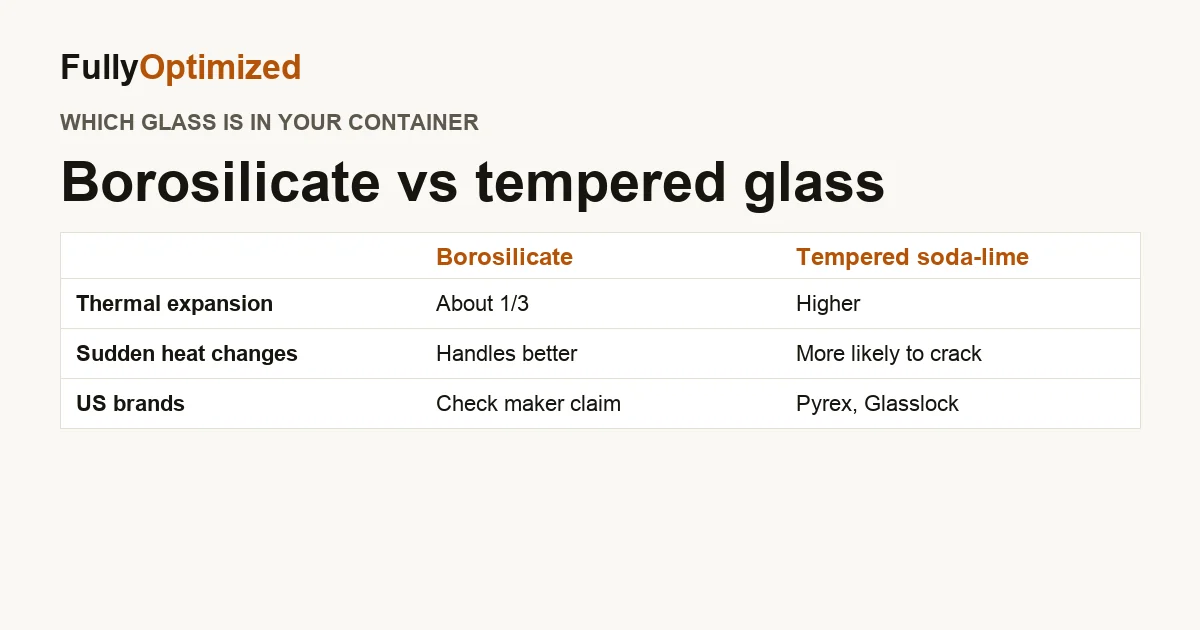
Borosilicate vs tempered soda-lime glass
| Borosilicate | Tempered soda-lime | |
|---|---|---|
| Thermal expansion | About a third of soda-lime[1] | Higher |
| Sudden temperature changes | Handles them better | More likely to crack |
| Knocks and drops | Depends on the product | Tempering is done to add strength |
| Typical US storage brands | Some import brands; check the maker's claim | Pyrex, Glasslock[3][4] |
Why US Pyrex is not borosilicate
Borosilicate glass was invented by Otto Schott in the late 1800s, and Corning built the original Pyrex brand on its own borosilicate recipe. Gizmodo's 2019 reporting found that Pyrex began making some cookware from tempered soda-lime glass in the 1950s, Corning licensed the brand to World Kitchen (now Corelle Brands) in 1998, and by nearly all accounts US Pyrex sold since then has been tempered soda-lime glass. PYREX in Europe is made by a different company that still uses borosilicate.[2] Today Pyrex describes its US storage line as heat-tempered glass.[3]
The same article quotes the U.S. Consumer Product Safety Commission as having received 850 reports of glass cookware shattering or exploding over seven years, and calling the risk low compared with the millions of pieces in use.[2] Glasslock, the other big name in US glass storage, lists silica, soda ash and limestone as its ingredients and calls its glass tempered, which also makes it soda-lime.[4] We compare the two in Pyrex vs Glasslock.
Using either glass without cracking it
These rules come from Pyrex's own care instructions and apply to soda-lime glass in particular.[5]
- Preheat the oven before the glass goes in.
- Never use glass on a stovetop, under a broiler or on any direct flame.
- Set hot glass on a cooling rack, potholder or dry cloth, never a wet or cold surface.
- Let hot glass cool before washing, refrigerating or freezing it.
- Plastic lids stay out of the oven.
So which should you buy?
For fridge storage and microwave reheating, tempered soda-lime glass is fine, and it is what most US sets are. Borosilicate is worth seeking out if you often move containers between freezer, oven and counter, as long as the manufacturer itself says the glass is borosilicate. Either way, glass is a better place for hot food than plastic; the plastic-free kitchen guide explains why heat is the part to fix first, and glass vs plastic food storage compares the two materials directly.
Common questions
Does borosilicate glass leach chemicals?
Very little. SCHOTT rates its BOROFLOAT 33 borosilicate in the top class for hydrolytic and acid resistance, and reports it unchanged after 24 hours in water or dilute acid at 95 C. Strong alkalis and hydrofluoric acid can etch it, but those are not kitchen conditions.
Is tempered glass safe for food?
Yes. Tempered soda-lime glass is what most US glass storage and bakeware is made of. The difference is heat handling: it resists knocks well but is less tolerant of sudden temperature changes than borosilicate, so follow the care rules.
How can I tell if my glass container is borosilicate?
Check what the manufacturer says, not the retailer listing. Pyrex describes its US storage glass as heat-tempered, and Glasslock lists soda ash and limestone, the ingredients of soda-lime glass. A logo or the age of a dish is not a reliable test.
Can borosilicate glass go from freezer to oven?
It handles sudden temperature changes better than soda-lime glass, but follow the maker's instructions for your specific container. Pyrex, for its soda-lime glass, says to let hot glassware cool before freezing it and to always preheat the oven.
Get new sleep and recovery reviews by email
One email when we publish a new hands-on review or a major update. No daily newsletter.
Sources
- SCHOTT, BOROFLOAT 33 technical details (checked 2026-10-17)
- Gizmodo, The Pyrex Glass Controversy That Just Won't Die (2019-03-16)
- Pyrex (Corelle Brands), Pyrex Simply Store product page (checked 2026-10-17)
- Glasslock USA, What is Glasslock? (materials FAQ) (checked 2026-10-17)
- Pyrex (Corelle Brands), Snapware Total Solution use and care (checked 2026-10-17)